Guided Diffusion PosteriorSampling for Elastic ParameterInversion with Angle-Stack SeismicData
21 Jul, 2026
Anjali Dixit, Francesco Brandolin, and Tariq Alkhalifah
GitHub: https://github.com/DeepWave-KAUST/dpsAVAinversion-pub
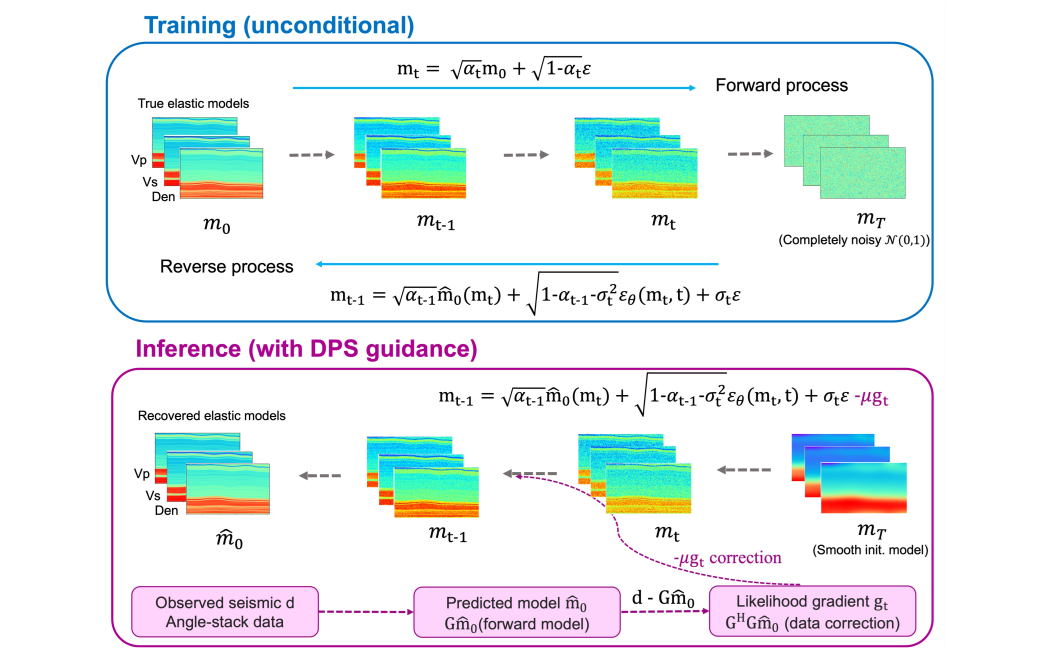
Elastic parameters are fundamental rock properties for improved reservoir characterization. However, their direct and reliable estimation from angle-stack seismic data remains a challenging inverse problem due to strong nonlinearity and imperfect physical modeling. Conventional deterministic approaches based on linearized Zoeppritz approximation yield a single point estimate and lack the ability to quantify solution uncertainty, while probabilistic methods are computationally prohibitive. To address these limitations, we present a unified workflow for accurate elastic parameters inversion from angle-stack seismic data using a guided diffusion model as an implicit prior over the joint distribution of P-wave velocity, S-wave velocity, and density. The diffusion model is trained in an unsupervised manner on benchmark datasets and well-log-derived synthetic models, learning the complex non-Gaussian statistical coupling among the three elastic parameters. For guidance, we employ the Diffusion Posterior Sampling (DPS) framework, which approximates the likelihood function through a forward modeling operator, based on the Aki-Richards approximation and injects data-consistency gradient corrections at each reverse diffusion step, thereby enabling the model to sample from a posterior distribution conditioned on the data-misfit between observed angle-stack data and modeled ones. To evaluate the effectiveness of the proposed framework, we perform a feasibility study using two datasets: the 2D Otway synthetic elastic model and field data from the Poseidon field, located in NW-Shelf in the Browse Basin, Australia. The results demonstrate the efficacy of the proposed guidance-based diffusion approach over two conventional inversion baselines: a least-squares inversion implemented via the LSQR algorithm, and an Alternating Direction Method of Multipliers (ADMM)-based method with total variation (TV) regularization. Quantitative comparisons confirm that the diffusion-based framework recovers sharper lithological contrasts and geologically more realistic elastic profiles. Additionally, uncertainty quantification is achieved by generating multiple independent posterior realizations through repeated reverse diffusion runs, yielding spatially resolved uncertainty maps for each elastic parameter.