SiameseFit: Latent Seismic Data Comparison for Enhanced Full Waveform Inversion and Cycle Skipping Mitigation
04 Jun, 2026
Omar M. Saad, and Tariq Alkhalifah
GitHub: https://github.com/DeepWave-KAUST/SiameseFit-pub
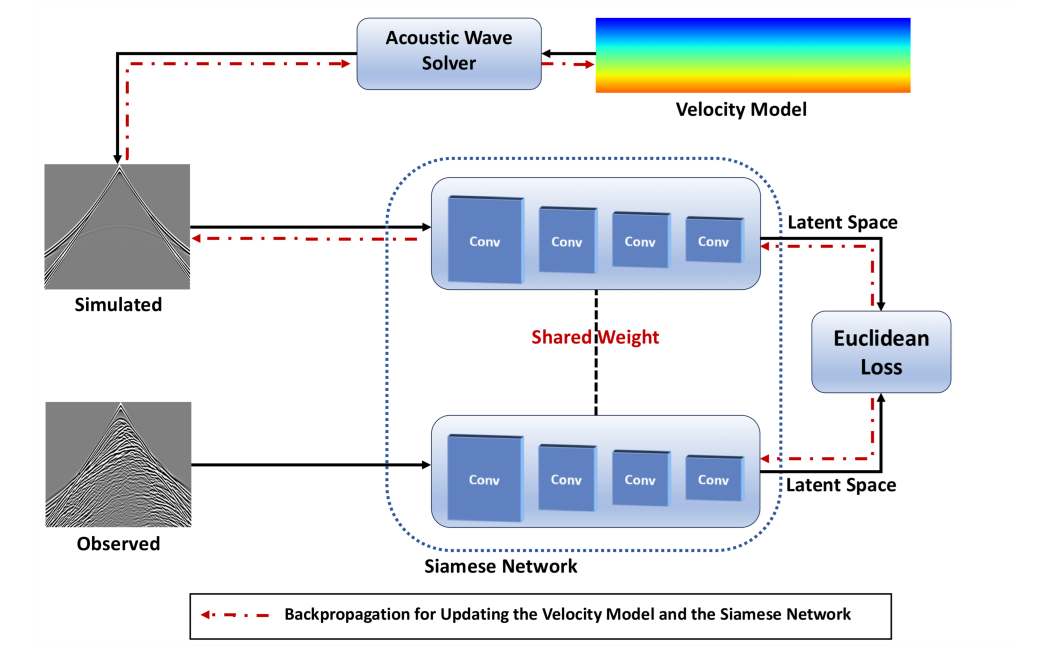
A self-supervised deep learning framework, SiameseFit, has been applied to improve Full Waveform Inversion (FWI) by mitigating the cycle-skipping problem caused by poor initial models. The method employs a Siamese convolutional neural network with shared weights to extract comparable latent-space features from observed and simulated seismic data. By performing the misfit calculation in the latent space using the Euclidean distance, the framework enables more robust feature alignment and stable inversion. SiameseFit effectively suppresses crosstalk noise in multi-source FWI, converges rapidly to high-resolution models even from constant velocity model, and outperforms conventional misfit functions and deep learning benchmarks. The latent-space representation learned by the network enhances the adjoint source update process, leading to more accurate velocity reconstructions.